
Release 26.09
Technical Release Details: https://github.com/esnet/StackV/releases/tag/26.09
Release 26.09 is our Q3 quarterly release, introducing integrated Project tracking, per-task access controls, and a large expansion of IRI and WAN Data Fabric orchestration. And as this release is part of our year-of-production sprint, we naturally also have major improvements to orchestrator model stability and observability.
⚠️ Breaking Changes
Section titled “⚠️ Breaking Changes”- Task endpoints now enforce individual task access. Reading a task requires
READaccess, updating its status or message requiresWRITEaccess, and archiving requiresOWNERaccess. API clients that previously relied on broad access to arbitrary tasks may now receive401,403, or404responses.- To remedy this, you may need to adjust the task’s tag or establish access control policies as needed.
✨ New Features
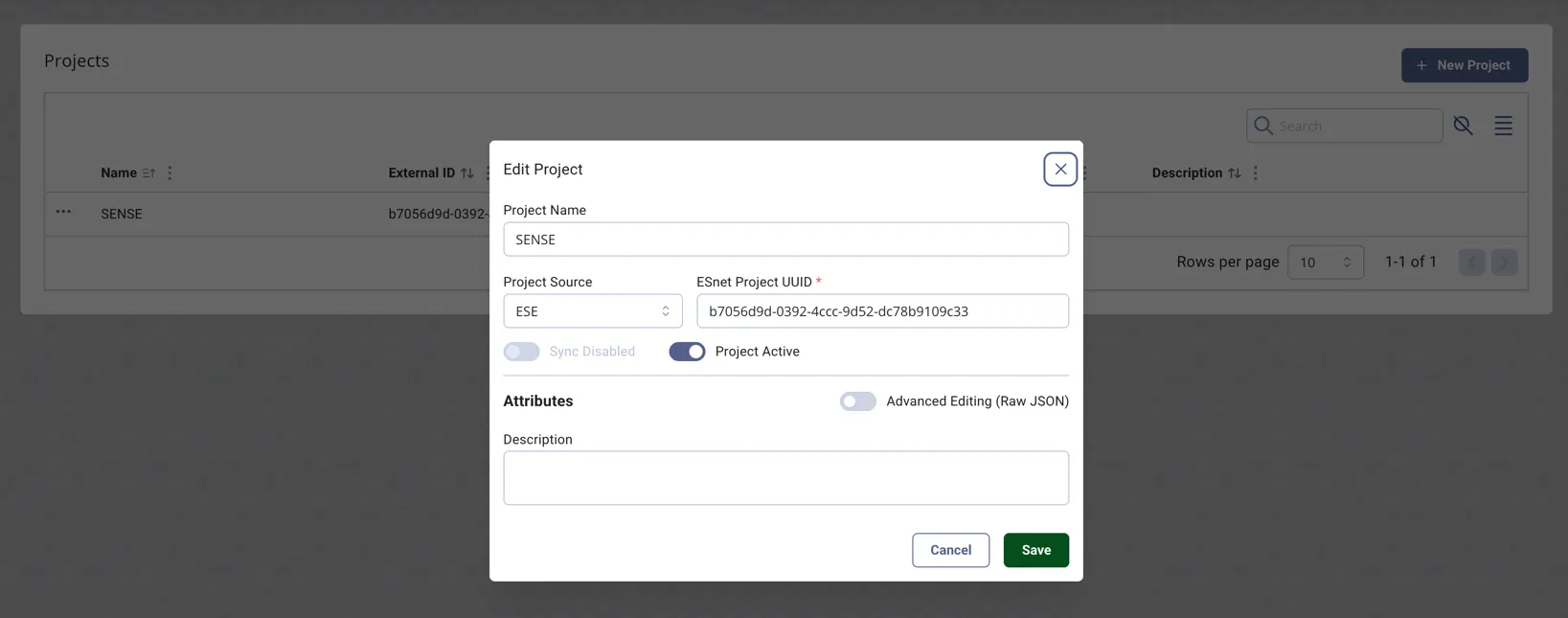
Section titled “✨ New Features”- Projects are now a first-class concept in SENSE-O. Administrators can record project definitions and associate
them
with users and groups, which will then be associated with any licenses or instances they create. A new project
association mode controls how those associations are applied along a new set of
/projectAPI endpoints.
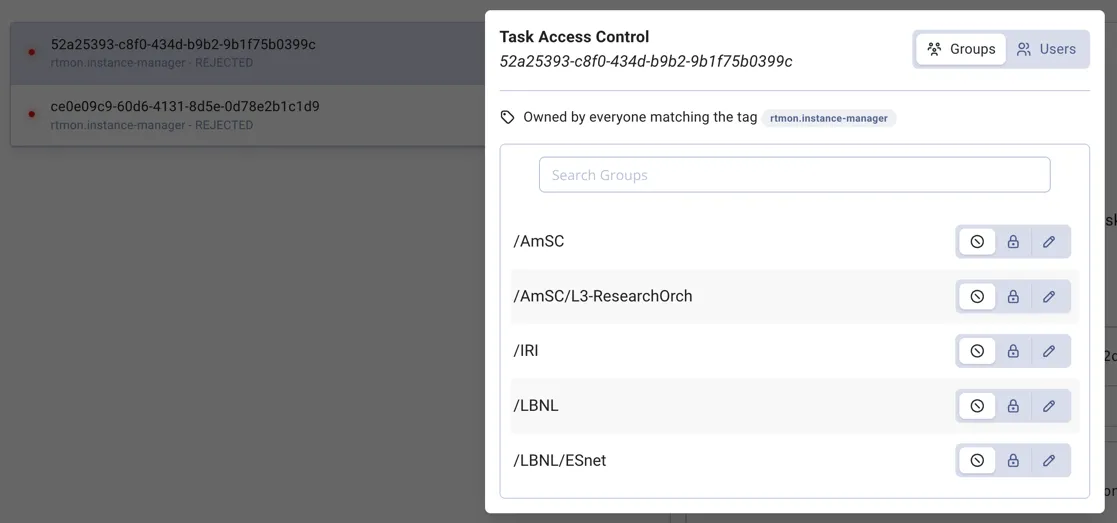
- Task Access Controls bring the same ownership model used elsewhere in SENSE-O to Tasks. Owners can delegate read, write, or owner access to other users directly from the task UI, and task rows now include a quick link to navigate to their parent.
- IRI and WAN Data Fabric orchestration has been significantly expanded:
- L3VPN support for the WAN Data Fabric, including optional BGP MD5 authentication keys, also available as an IRI Facility Space network parameter.
- L3 routing over facility interconnects, with local and remote addressing defined from the facility’s perspective.
- A new
facilityendpoint type for WAN Data Fabric connections, and improved subnet resolution for L2VPN and job placement. - New IRI facility routing and compute switching services.
- Support for the IRI v2 API, with continued support for v1.
- Observability improvements across the portal and backend:
- Instances now have clearer observability and audit tracing in the details view.
- System Health now reports more comprehensive monitoring information, along with diagnostic model metrics.
- The Driver table now shows overall health metrics across the board.
- Model-cache resets are faster, and the cache layer is more resilient under unstable conditions.
Minor Additions
Section titled “Minor Additions”- The orchestrator container now ships with a built-in healthcheck against the version endpoint, and our Docker Compose templates have been updated to match. Operators maintaining their own Compose or Helm definitions should adopt the new check.
- The JVM now writes a heap dump and exits on an
OutOfMemoryErrorinstead of stalling, keeps a rotating GC log in the server log directory, and warns at startup ifJAVA_MEMORYis set below the recommended floor. - Container images now include SBOMs and better multi-platform support.
🐛 Bug Fixes
Section titled “🐛 Bug Fixes”- Fixed HTTP client starvation when dozens of authentication challenges ran simultaneously.
- Fixed address pools allocating subnets outside their configured range.
- Fixed several model-cache miss and lock issues that could stall orchestration.
- Fixed slow portal loading and redundant requests when Keycloak is under load.
- Fixed a client leak in the user service.
- Fixed a stale layout state that could break the visualization when nodes were missing.
- Fixed soft-capped QoS not always releasing bandwidth.
- Timekeeping and date rendering are now centralized across SENSE-P for consistent display.
🚧 Known Issues
Section titled “🚧 Known Issues”- Project synchronization from external sources is not yet available, but is being actively developed.